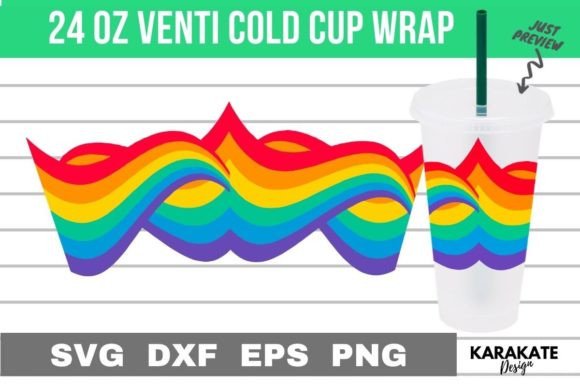
Rainbows, 24 Oz Venti Cup Wrap SVG
Let’s talk about the Rainbows, 24 Oz Venti Cup Wrap SVG — not as a listing on a digital marketplace, but as a design I held up against the light of real embroidery work. I tested it last week while prepping a batch of custom embroidered tote bags for a local coffee shop’s holiday pop-up. The client wanted cheerful, reusable merch that felt handmade but polished — no clip-art energy, no pixelated edges, nothing that whispered “I downloaded this at midnight.” That’s where this file landed: somewhere between playful and professional.
A Design That Breathes on Fabric
First impression? It’s light. Not lightweight in execution — the curves are smooth, the arcs intentional — but emotionally light. There’s air around the rainbow shape, and the wrap format means it naturally follows gentle curvature without distortion. As a machine embroidery design, it doesn’t scream for attention; it invites a smile. That matters when you’re stitching onto baby onesies or kitchen towels meant to live in real homes, not staged photos.
I opened the SVG first (since vector clarity tells you everything about scalability), then checked the PNG at 300 DPI with transparent background — critical if you’re building printable mockups or layering over product photos for your Etsy shop. All four files — SVG, DXF, EPS, PNG — loaded cleanly into my design software and scaled without jagged edges. That consistency across formats is rare in Graphics aimed at crafters, and it signals thoughtful prep, not just automated export.
Where This Rainbow Actually Shines
This isn’t a standalone logo or a dense monogram. It’s a tote bag design waiting to happen. I stitched it on a medium-weight canvas tote using a satin stitch border and soft fill stitch gradients — and yes, it held up beautifully after two rounds of washing and daily use. It also translated well onto a relaxed-fit sweatshirt sleeve, where the curve hugged the seam naturally. For custom apparel, that’s gold: minimal hooping tension, no awkward stretching, no need to reposition mid-stitch.
It worked surprisingly well on a child’s denim jacket pocket — small enough to feel intentional, large enough to read clearly. As a personalized gift, it adds warmth without clutter. I’ve seen too many “rainbow” designs go cutesy or chaotic; this one stays grounded in balance. The spacing between bands feels generous, not cramped — which directly impacts stitch density. Lower density = less puckering on delicate fabrics like cotton lawn or baby rib knit.
For Etsy sellers and small shop products, it’s versatile branding fuel: pair it with neutral thread (ecru on oatmeal linen, navy on cream canvas) and it reads boutique; switch to brights on black fabric and it becomes festival-ready. And because it’s sized for a 24 oz Venti cup wrap, the proportions are inherently friendly for curved surfaces — meaning it adapts cleanly to mugs, water bottles, and even the rounded edge of an apron pocket.
Where to Pause — and Test First
Don’t assume it’s foolproof everywhere. On thin or stretchy fabric — think lightweight tees or jersey baby caps — the outer curves can pull if stabilizer isn’t layered thoughtfully. I recommend tear-away + light cut-away combo for anything with movement. Also, avoid placing it near seams or hems unless you’ve test-stitched on scrap: the wrap format leans slightly toward the top edge, so alignment shifts on uneven surfaces like structured caps or pillow covers with piping.
Dark fabric? Yes — but only with high-contrast thread. The design’s openness means low-density fills won’t pop on black without careful color choice. And while it’s clean in black-and-white mockups, avoid shrinking it below ~3.5 inches wide: fine arc transitions blur in tiny scale, especially in applique design workflows where raw edges matter.
What It Adds to Your Finished Product
This embroidery file elevates perceived value without demanding premium pricing. Customers notice the difference between “a rainbow” and this rainbow — the kind that feels considered, not copied. On nursery decor or holiday gifts, it reads as gentle and inclusive. On café merch or boutique branding, it reads as approachable and human. That emotional resonance builds customer trust faster than any tagline.
For creative entrepreneurs, it’s a reliable asset in your design assets library — not a one-off, but a repeatable element you can recolor, pair with simple text, or nest within borders for seasonal variations. And because it’s delivered as both vector and raster files, it bridges embroidery and print: use the SVG for digitizing, the PNG for social media banners or packaging labels.
Practical Designer Notes — Before You Stitch
- Always test on scrap fabric first — especially if using textured weaves or blends. What looks smooth on screen may catch on slubs or loops.
- Check thread color contrast before stitching on dark or busy backgrounds. A pale yellow band disappears fast on mustard linen.
- Review stitch density in your embroidery software. If it’s over 12,000 stitches, consider simplifying fills for baby items or lightweight garments.
- Confirm hoop size compatibility. While the wrap format suggests flexibility, tight hoops under 4x4" may require repositioning — verify before committing to a full run.
- Inspect small details at 200% zoom: are arc endpoints clean? Do corners taper smoothly? This affects satin stitch flow.
- Test in black-and-white mockups — helps spot unintended visual weight imbalances.
- Compare light and dark fabric backgrounds side-by-side. Some rainbow palettes lose harmony when inverted.
- Use proper stabilizer: medium-weight cut-away for knits, tear-away for stable wovens, and fusible for lightweight layers.
- Verify licensing before selling finished items or bundling the file in digital product kits. This Crafts listing doesn’t state terms — always confirm.
In short: the Rainbows, 24 Oz Venti Cup Wrap SVG is a quiet performer — not flashy, not fussy, but deeply functional. It fits the rhythm of real embroidery project life: quick to load, easy to adapt, and thoughtful enough to reflect well on your handmade product. Whether you’re stitching for joy, gifting with intention, or building a craft business, it earns its place in your workflow — not as decoration, but as dependable design sense.